
Frequently asked questions
Everything you need to know before pre-registering. Type a word (price, prescription, smoking, result…) to find your answer.
Who is it for?
Who is this test most useful for?
This test is most useful when the risk of cancer is higher:¹
- from age 50;
- if a close relative (father, mother, brother, sister or child) has had cancer;
- if you have had cancer before;
- if you smoke or used to smoke heavily;
- if you drink alcohol regularly;
- if you have a chronic inflammatory condition.
What about before age 50? You can still take the test. In younger people, hPG80 levels are generally very low, so a high level is a strong, clear signal (with less risk of a false positive) that should be explored with a doctor.¹
Pregnancy and under-18s: no studies have been carried out. The test's effectiveness has not been demonstrated in these situations, so it is not recommended.¹
Who should take the test?
No one has to take this test: it is a preventive step that you can choose to take, or not.
Before you go ahead, ask yourself a simple question: are you ready for either answer? Your result may reassure you, or it may suggest that further investigation is needed.
An intermediate or high level does not mean cancer: it leads to further tests prescribed by a doctor, because no test is infallible.¹
This test complements organised screening programmes; it does not replace them. Worried about an unusual sign? See your doctor first.
What are the contraindications?
The test has not been evaluated in people under 18 or in pregnant women: there are no data to assess its reliability in these situations.¹
Tell your doctor: active smoking and COPD can raise the level even when there is no cancer. Other inflammatory conditions are being studied.¹
Unsure? Describe your situation in the health questionnaire: the doctor will take it into account.
I'm pregnant. Can I take the test?
The test has not been studied in pregnant women, so we do not know whether its results would be reliable during pregnancy. A false positive could also cause unnecessary worry at a time when your peace of mind matters.¹
For any questions about your health during pregnancy, the healthcare professional looking after you is still the best person to speak to. After your pregnancy, you can discuss the test with your doctor again.¹
I have no symptoms. Do I need the test?
This test is not compulsory: it is a preventive step that you are free to choose.
In its early stages, cancer often causes no symptoms. Checking before symptoms appear is what early detection is all about: the earlier a cancer is detected, the better the chances of treating it.¹
Our test complements organised screening programmes (breast, colorectal and cervical); it does not replace them. A doctor will always explain your result during a 30-minute video consultation. Not sure? Talk to your doctor.
I have symptoms. Do I need the test?
If you have a symptom, the right first step is to talk to your doctor before taking any test. They will prescribe the appropriate investigations to find the cause.
certain signs should prompt you to see a doctor: persistent pain or a persistent cough, unusual bleeding, unexplained weight loss, a lump or a mole that changes.²
Remember: a symptom does not necessarily mean cancer. Our test is a preventive step; it does not replace a medical consultation.¹
I smoke. Can I take the test?
Yes, as long as you let us know. The measured level can be high without cancer in people who currently smoke, and in people with COPD, a chronic respiratory condition; these levels are generally lower than those seen in cancer.¹
Include this in your health questionnaire: the doctor from our panel will take it into account when explaining your result.
Are you aged 50 to 74, and do you smoke or did you stop less than 15 years ago? Since May 2026, the IMPULSION pilot programme has offered low-dose CT scans and support to stop smoking in five regions. Talk to your doctor.
Does stopping smoking change the result?
Smoking raises hPG80 levels, even without cancer. After quitting smoking, the level may return to the low range within the following month.¹
In a study published in 2025 involving people without cancer, levels were higher in smokers than in non-smokers, particularly among those who had smoked heavily and for a long time.³
In former smokers, levels had returned to those of people who had never smoked, except in those who already had cancer.¹
Do you smoke? Let us know before your test: the doctor will take it into account and may suggest measuring your level again at least one month after you stop.
I'm afraid of what I might find out
Take your time. This test is a choice, not an obligation.
That's understandable. Many people feel this fear. This test is not for everyone.
You're not alone. A doctor will spend 30 minutes explaining your result, whatever it is.
Your result
Your result in 3 ranges
Your hPG80 level is expressed in picomoles per litre (pmol/L). The doctor interprets it using three ranges.¹
Below 3.3: low level, weak signal. No specific action is needed if you have no symptoms. The doctor may suggest repeating the test later if you are at increased risk.¹
From 3.3 to 10.9: intermediate level. The doctor considers your circumstances (medical history, smoking and symptoms) and may suggest other tests, followed by another measurement to see how the level changes.¹
Above 10.9: high level. Further investigations, guided by clinical findings, often involving imaging.¹
In every case, no decision is made on this number alone.
What if my level is high?
A high level tends to be a strong signal. It is not a conclusion: its cause needs to be investigated with a doctor.¹
Your result is sent to the doctor you selected from our panel. They will explain it during the 30-minute video consultation included in the price. Further investigations prescribed by a doctor can help identify the cause.
What if the level is intermediate? It may not be related to cancer (smoking, an inflammatory condition, etc.). Other blood tests may be suggested; if they are normal, a repeat check is planned at 12 months. You will never be left to face your result alone.¹
What if my level is low?
That is reassuring, but no test is perfect: a low level does not rule everything out.¹
If you have no symptoms, no specific follow-up is recommended after a low result. The risk of a false negative varies by cancer type.¹
Your doctor, who is trained in functional medicine and specialises in prevention, will help you explore any concerns or symptoms during the 30-minute video consultation.¹
Keep up with your usual screening: respond to invitations for organised screening programmes, and see your doctor if a symptom appears.
What can raise hPG80 levels without cancer
Your hPG80 level may be slightly higher even when there is no cancer. Known situations include:¹
- active smoking (another measurement may be suggested at least one month after stopping);
- COPD (a chronic respiratory condition);
- chronic inflammatory conditions, such as rheumatoid arthritis or Crohn's disease;
- cirrhosis or chronic liver disease;
- diabetes;
- certain medicines for stomach acidity (a slight increase);
- the period following chemotherapy (a temporary increase).
Even in these situations, the level generally remains lower than in cancer, but the risk of a false positive increases.¹
Include these in your health questionnaire: the doctor will take them into account when interpreting your result.
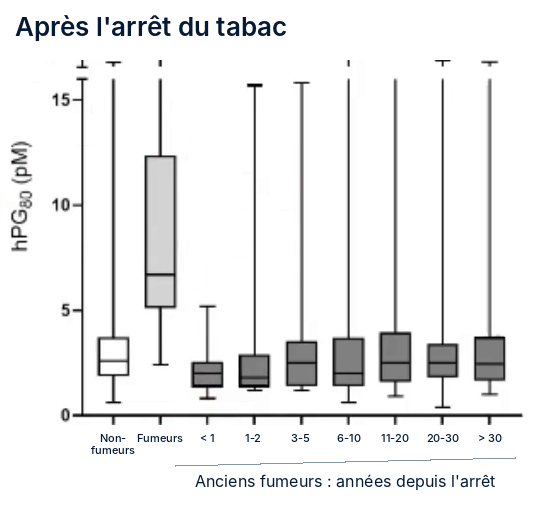
After quitting smoking, the level may return to the low range within the following month.¹
Is there a risk of false positives?
Yes, as with any test, there is a risk. A false positive means an intermediate or high level when there is no cancer.¹
It depends on the level. A high level tends to be a strong signal. An intermediate level, however, may not be related to cancer.¹
Certain situations can raise the level without cancer: smoking, COPD, chronic inflammatory conditions, liver disease, diabetes, certain medicines for stomach acidity (PPIs), and recent chemotherapy. Levels are then generally lower than in cancer, but the risk of a false positive increases. Include these in your health questionnaire, which you complete before your blood sample is taken.¹
See: What can raise hPG80 levels without cancer¹
A result is never a conclusion on its own. The doctor from our panel will explain it during a video consultation and, if needed, prescribe further investigations to find the cause.
Is there a risk of false negatives?
Yes, it is possible: a false negative means a low level when cancer is present. This risk varies from one type of cancer to another.¹
A low result is reassuring, but it does not rule everything out. The test has been studied in 16 types of cancer, not in others.¹
Keep up with organised screening programmes (breast, colorectal and cervical), whatever your result. If an unusual sign appears or persists, talk to your doctor, even after a low result.
How often should I repeat the test?
There is no single schedule. Your doctor will tell you when to repeat the test, usually between a few months and a year, depending on your result and your risk.
One specific situation is planned for: after an intermediate level, if the additional tests are normal, a repeat check at 12 months.¹
Organised screening programmes keep their own schedules: every two years for breast and colorectal screening (from ages 50 to 74), and every three to five years for cervical screening, depending on age.
The process
How does the blood test work?
It all starts online: you order on our website, receive a unique code and choose the doctor who will receive your result.
Before your blood sample is taken, you complete a short health questionnaire (medical history, smoking, alcohol, medication, etc.) to help the doctor interpret your result.¹
You then visit one of our more than 900 partner laboratories, most of which do not require an appointment, for a standard blood draw. You do not need to fast.
You then book an appointment with your chosen doctor to receive and discuss your results during a video consultation.
How long will it take to get my results?
The laboratory analysis takes 30 days. Your full results are presented by a doctor trained in functional medicine during a 30-minute consultation included in your package.
You choose the date and time slot that suit you for this appointment.
Do I need a prescription?
No. With Prevonco, you do not need a prescription: after ordering online, a unique code gives you access to the test at one of our partner laboratories. In France, some laboratory tests can be carried out at your request, without a prescription.
No prescription, but still a doctor: they remain central to the process. Your result is sent to the doctor you selected from our panel, who will explain it during a 30-minute video consultation, included whatever the result.
Are you receiving care for cancer? Speak directly to your oncologist: they can prescribe this test without going through Prevonco.¹
For any questions about your situation, or if you have symptoms, your doctor remains your first point of contact.
Who is the doctor?
You choose your doctor from our panel when you order. All are trained in functional medicine, specialise in prevention and have received specific training in interpreting the results of this test.
During a 30-minute video consultation, whatever your result, they will explain it, answer your questions and guide you.
Intermediate or high level: they know which further investigations to prescribe and which specialist to refer you to. Low level: they support you with any other questions or concerns.¹
My doctor has never mentioned it
A relatively new test: many doctors are not yet familiar with it. That is normal for a new laboratory test.
Talk to them about it. Invite your doctor to write to us at contact@prevonco.fr: we will send them information about the test. If they are interested in prevention, they can also join our panel of doctors.
In every case, a 30-minute video consultation with a doctor from our panel is included, whatever the result.
Are my data protected?
Your data are processed in accordance with the GDPR and French rules on health data. They are hosted in an environment certified for health data hosting (HDS).
They are encrypted both at rest on our servers and during transfer (HTTPS), using up-to-date encryption algorithms. Your result is shared only with the doctor you have chosen to oversee your care.
Pricing and reimbursement
What does the €389 price include?
€389, all included: the blood draw and analysis at one of our more than 900 partner laboratories. And, importantly, a 30-minute video consultation with a doctor trained in functional medicine who specialises in prevention, whatever your result.
This conversation accounts for a significant part of the price: the doctor explains your result, answers your questions and guides you.
No hidden costs: no prescription to pay for, and no extra consultation needed to understand your result.
This test is not compulsory. If the cost makes you hesitate, start with organised screening programmes (breast, colorectal and cervical), which are covered at 100%.
Is it reimbursed? Why not yet?
No: even when prescribed by a doctor, the test is not covered by Assurance maladie.
In France, a test is reimbursed when official recommendations provide for it. These are based on very large studies that take time and are costly.¹
For hPG80, these studies are being prepared: a European consortium is launching a large-scale lung cancer study. If its findings are conclusive, an application for coverage can be submitted.¹
In the meantime, the patient pays for the test: €389, including the blood draw, analysis and 30-minute video consultation. Remember organised screening programmes too: they are offered by invitation, with no upfront payment, such as mammograms every two years from ages 50 to 74.
Prevonco and organised screening programmes
Does it replace organised screening programmes?
No, it complements them. Our test replaces neither organised screening programmes nor your doctor's advice.
Breast and colorectal screening: from ages 50 to 74, every two years. Cervical screening: from ages 25 to 65, at intervals that depend on age. Lung screening: since May 2026, the IMPULSION pilot programme has offered low-dose CT scans in 5 regions to current and former smokers aged 50 to 74.
Already taking part? Keep going: these programmes are free and covered at 100%. Our test has been studied in 16 types of cancer, many of which have no organised screening programme. It adds to your screening; it does not replace it.¹
I am not familiar with Prevonco
Prevonco is a French brand run by a company based in France.
Our role: to make a blood test that helps with the early detection of 16 types of cancer available to the general public, without a prescription.¹
The test, DxPG80.Lab, is manufactured by Biodena Care. It is CE-marked and analysed within a network of laboratories in France.¹
A complete pathway: a blood draw close to home, followed by 30 minutes with a doctor to explain your result.
Have another question? Email us at contact@prevonco.fr
An aid to early detection: it does not replace organised screening, imaging tests or your doctor's advice.
Prevonco is currently available in France only.
An aid to the early detection of 16 cancers
No prescription needed, for people without symptoms. If you have an unexplained symptom, see your doctor first.
Pre-register for free →Sources
- 1.biodena.care
- 2.INCa, Panorama des cancers en France 2026
- 3.Vire et al., Biomarker Research, 2025
How the test works
What does the test measure?
The test measures the amount of a protein called hPG80 in your blood, which is released by many cancer cells.¹
Across 26 studies involving nearly 1,200 healthy volunteers and more than 4,000 patients, higher levels were observed in people with cancer, across 16 types of cancer and at every stage.¹
The test, DxPG80.Lab, is developed by Biodena Care and is CE-marked. It does not tell you where a possible cancer is located: a high level is a signal to explore with a doctor.¹
Where does the signal measured by the test come from?
Without cancer, this protein is barely present in your bloodstream. With cancer, it may appear.¹
In the stomach, cells produce a digestive hormone called gastrin. To make it, they first produce a preliminary form: progastrin. This is immediately converted into gastrin. That is why progastrin is almost never found in the blood of a healthy person.
Cancer cells, however, need this progastrin to survive. They block its conversion into gastrin and release it into the blood. This circulating form is called hPG80.¹
This is the signal our test measures, using a simple blood sample. It does not tell you where the cancer is located: a high level should always be discussed with a doctor.¹
hPG80? I've never heard of it
Studied for over 20 years. Progastrin, of which hPG80 is the form found in the blood, has been the subject of scientific publications for over 20 years.¹
A more recent test. Measuring it in the blood is more recent, which is why it is still not widely known.
Some references: Siddheshwar, Gut, 2001 · Prieur, Clinical Cancer Research, 2017 · You, EBioMedicine, 2020 · You, Biomarker Research, 2025.
To learn more, explore the science behind the test on our The science page.
Which cancers can the test help detect?
High levels have been observed in 16 types of cancer in clinical studies: lung, pancreatic, liver, colorectal, breast, prostate, ovarian, uterine, kidney, oesophageal and stomach cancers, cutaneous melanoma, uveal melanoma, neuroendocrine tumours, glioblastoma, and head and neck cancers.¹
The test has not been studied in other cancers. It also does not tell you where a possible cancer is located: that is the role of further investigations.¹
You can find a fact sheet for each cancer on the The 16 cancers page.¹
What about cancers not covered by this test?
The test has been studied in 16 types of cancer. It has not been studied in others, so we do not know whether it can detect them.¹
Organised screening programmes remain essential: breast and colorectal screening from ages 50 to 74, and cervical screening from ages 25 to 65. An unusual sign that persists? Talk to your doctor.
Which stages does the test cover?
In clinical studies, high levels were observed from stage 1 onwards, and at every stage of cancer.¹
This matters: according to INCa, earlier detection allows less intensive treatment for many cancers.¹
The test has not been studied in all cancers: the studies show conclusive findings for 16 types of cancer. It complements organised screening programmes; it does not replace them.¹
Detection or location?
Detection, not location. The test picks up a signal in the blood that has been observed in 16 types of cancer, but it does not tell you where that signal comes from.¹
A high result alone therefore cannot confirm cancer or locate it. That is the role of further investigations, prescribed by a doctor based on your situation.¹
The doctor from our panel will explain your result during the 30-minute video consultation included in the price and guide you towards the appropriate next steps.
Does CE marking prove that it works?
The test is CE-marked: it meets European regulations for in vitro medical devices, which require evidence of performance, including its ability to detect the signal.
In the studies, hPG80 levels are significantly higher in people with cancer, regardless of stage.¹
What it does not tell you: CE marking does not prove that taking this test reduces mortality.
Detected earlier, treated more effectively: cancer found early generally offers much better chances of survival.¹