
Why prescribe this test?
An overview for doctors: what the test measures, how to interpret the result and where it fits in your patients' preventive care pathway.
We work with functional medicine doctors committed to preventive healthcare.
The hPG80 protein, measured with a simple blood test.
The test measures hPG80, or circulating progastrin, using a quantitative ELISA assay performed in a laboratory on a simple blood sample. It is a CE-marked test.
16 types of solid cancer
Elevated hPG80 levels have been observed at every stage.
The data
26 studies, 4,045 cancer patients and 1,199 healthy people.

Median hPG80 level by cancer stage
pmol/L
A result in 3 ranges.
Low level
< 3.3 pmol/L
Result in the low range.
Intermediate level
3.3 to 10.9 pmol/L
Interpret in the clinical context, alongside other tests and a repeat measurement.
High level
> 10.9 pmol/L
Further tests, guided by clinical findings, often including imaging.
Factors that can raise levels without cancer
Active smoking and COPD can raise hPG80 levels. After quitting smoking, the level may return to the low range within the following month.¹
Learn more in the FAQ →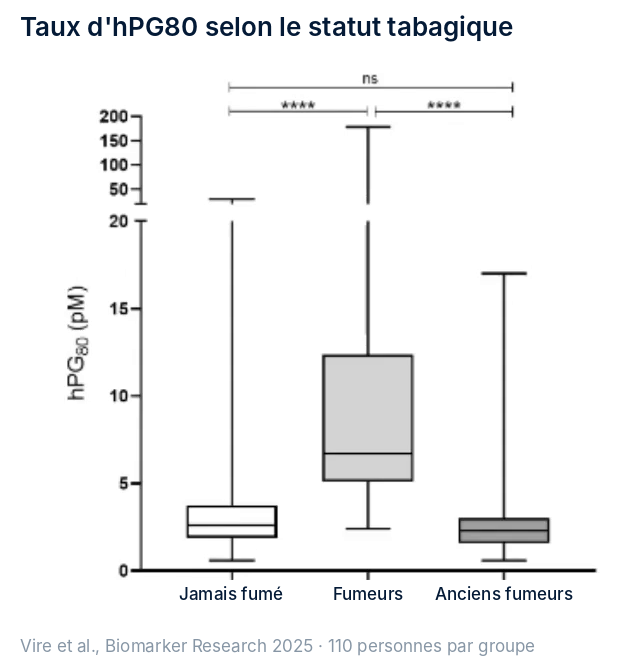
The role of the test
It is an aid to cancer detection, complementing organised screening, never replacing it. It does not locate the tumour.
Who is it for?
For people without symptoms who want to take a preventive approach. If symptoms are present, the usual medical assessment takes priority.
Join our panel to support our clients
Sources
- 1.biodena.care
- 2.Vire et al., Biomarker Research, 2025
- 3.You et al., EBioMedicine, 2020