
The science
What hPG80 can tell us. What the studies show. And what this test cannot promise.
hPG80¹ : a protein that cancer cells struggle to hide.
French research and development has identified that the protein hPG80¹ — a circulating form of progastrin — is present at elevated levels in the blood of patients with 16 different types of cancer, regardless of disease stage. The DxPG80 test precisely measures this protein using a simple blood sample.
tested (and 1,200 healthy participants) to validate the test's performance.
with elevated levels observed from stage 1.
The test is developed by Biodena Care ²and its parent company, Progastrin, which grew out of French research (Inserm, Montpellier): more than 10 years of research into the hPG80 protein.
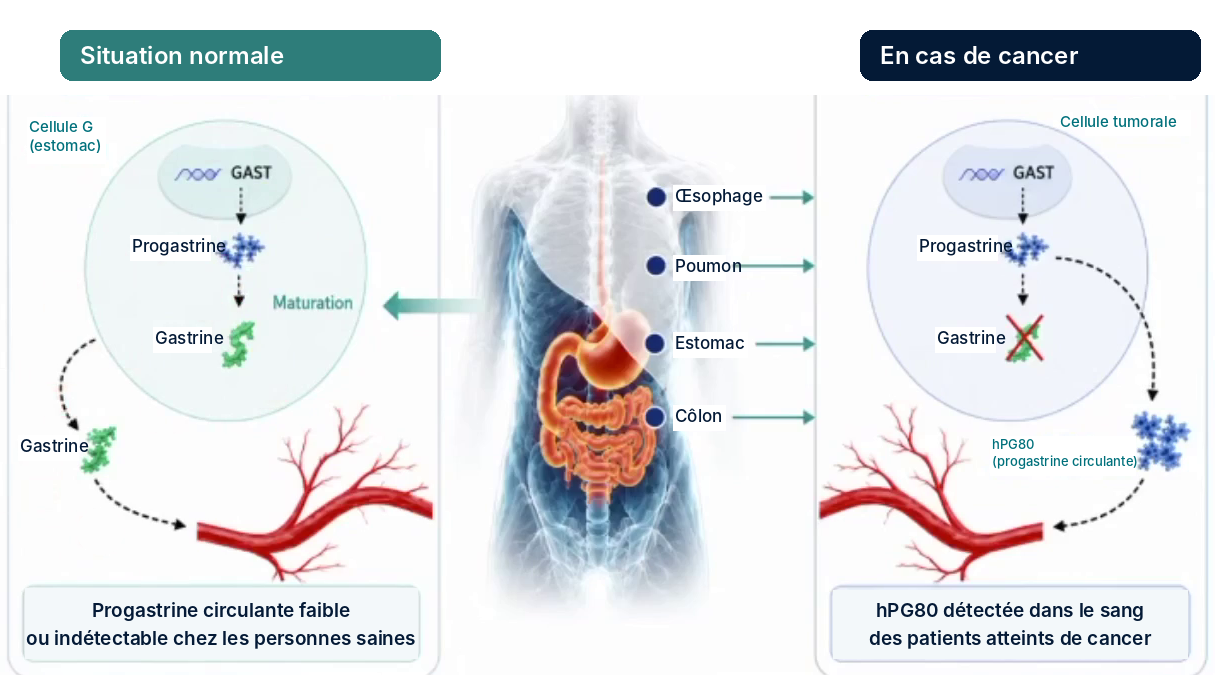
What published research shows abouthPG80¹.
The data below come from scientific publications compiled by the supplier of the test and technology used by Prevonco. The Prevonco service is for detection only; other uses belong within a care pathway supervised by a doctor.
Median hPG80 level by cancer stage
pmol/L
Cancer detection
Case-control studies show significantly higher hPG80 levels in more than 4,000 cancer patients than in nearly 1,200 healthy participants, across 16 types of cancer.
²Prognosis
In 4 published studies (metastatic kidney cancer, liver cancer, breast cancer and glioblastoma), elevated hPG80 levels are associated with less favourable clinical outcomes.
²The 16 types of cancer evaluated in the clinical cohorts.
Patients in the clinical studies were divided into 16 separate cohorts, one for each type of cancer. For each cohort, hPG80 levels were compared with those of healthy people.
- 01Colorectal cancer
- 02Prostate cancer
- 03Stomach cancer
- 04Esophageal cancer
- 05Ovarian cancer
- 06Uterine cancer
- 07Liver cancer
- 08Pancreatic cancer
- 09Lung cancer
- 10Kidney cancer
- 11Breast cancer
- 12Head and neck cancers
- 13Glioblastoma
- 14Skin melanoma
- 15Uveal melanoma
- 16Neuroendocrine tumors
Limitations of this test.
The DxPG80 test is an aid to early cancer detection. It does not replace organised screening, imaging tests, your doctor's advice or a clinical examination. Nor does it replace organised cancer screening programmes (breast, colorectal and cervical cancer).
This test cannot detect every cancer.
This test cannot locate cancer.
The result will be sent only to your selected doctor, whom you will then need to meet to have your results explained.
It depends on the level: a high level is generally a strong signal; an intermediate level may not be related to cancer. A low level cannot rule out all cancers. If your level is high, further tests prescribed by a doctor can help investigate the cause.
Doctors' area
Prevention starts with an informed conversation.
We work with functional medicine doctors committed to preventive healthcare.
Discover the DxPG80 test, developed by Biodena Care, and the scientific evidence on hPG80. Your expertise remains essential in interpreting results and supporting each patient.
Scientific documentationDxPG80: measuring circulating hPG80.
hPG80 is a circulating form of progastrin studied in oncology. The DxPG80 test measures its concentration in human plasma. Biodena Care describes it as a quantitative sandwich ELISA assay, intended for professional laboratory use and bearing the CE mark.
A blood sample
An hPG80 assay using EDTA plasma. Pre-analytical and analytical procedures must follow the manufacturer's instructions.
Published evidence
Research covers detection, prognosis, prediction of treatment response and treatment monitoring. These uses and their levels of validation must be considered separately.
Your clinical judgment
A laboratory result alone cannot establish whether someone has cancer. It must be interpreted alongside the patient's history, clinical examination and relevant further investigations.
A complementary tool, never a definitive answer on its own.
An elevated hPG80 level alone cannot confirm or locate a cancer. A low level cannot rule out all cancers. The test does not replace recommended screening. It is intended for adults and is not intended for pregnant women.
Explore the evidence and the test's limitations Explore the science.
Moving prevention forward.
Technical and scientific documentation for the DxPG80 test, clinical publications and information for doctors interested in supporting Prevonco patients.
Prevonco is currently available in France only.
An aid to the early detection of 16 cancers
No prescription needed, for people without symptoms. If you have an unexplained symptom, see your doctor first.
Pre-register for free →