
How does hPG80 work?
A circulating protein measured in the blood, whose level is always interpreted by a doctor.¹
Why it increases in cancer
Cells exchange signals that regulate how they function. In many cancers, a signalling pathway called Wnt/β-catenin is abnormally activated.²
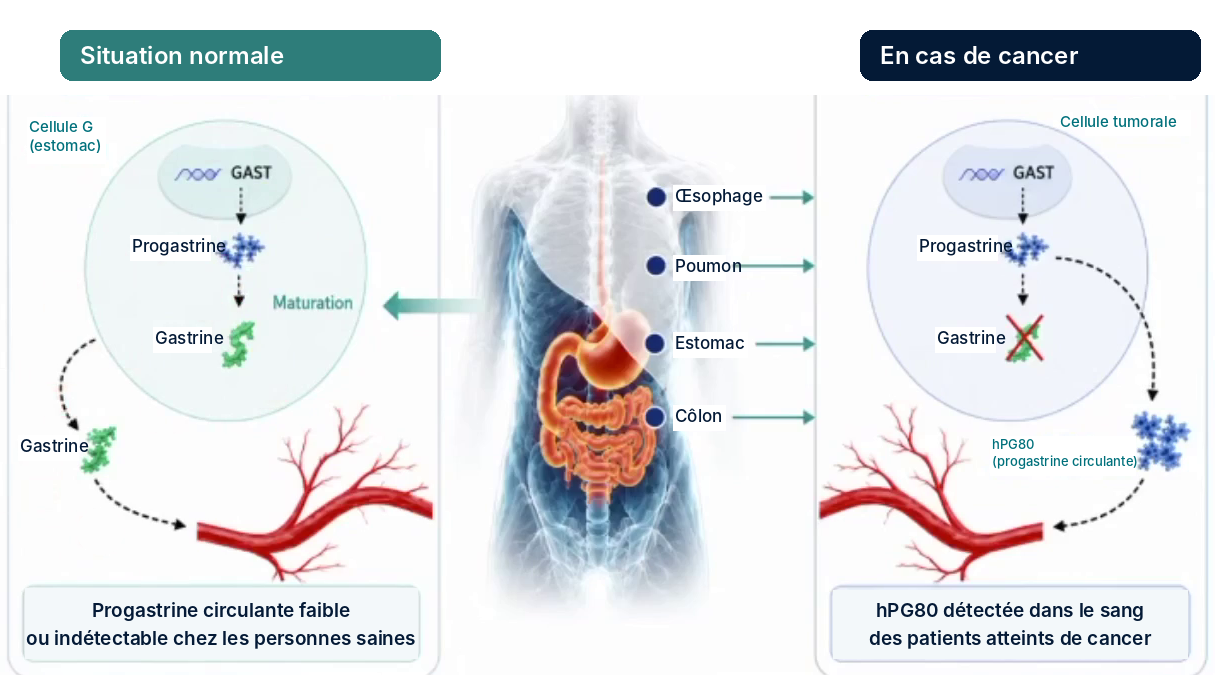
This activation causes overexpression of the GAST gene: the cells produce more progastrin. Cancer cells then release it into the blood in its circulating form, hPG80. The assay measures the amount of this protein.²
Median hPG80 level by cancer stage
pmol/L
Its role in the tumour
Progastrin contributes to tumour cell multiplication and resistance to cell death. Cell death is a natural mechanism that allows the body to eliminate certain cells.²
It also helps maintain cancer stem cells. These cells can replenish the tumour cell population and are involved in tumour progression and dissemination, meaning spread to other parts of the body.²
What the test measures
The test involves a simple blood draw. The laboratory uses plasma, the liquid part of blood, to perform the DxPG80.Lab assay. This assay measures the amount of hPG80 and reports the result in pmol/L, a unit of concentration.¹

The result falls into one of three interpretation ranges. These ranges give the doctor a reference point for interpreting the level alongside other information about your health.¹
What the test does not tell you
The test does not indicate where a possible cancer is located. It measures a protein in the blood without identifying the organ involved.¹
Certain factors can raise the level without cancer being present: current smoking, COPD (chronic obstructive pulmonary disease, a respiratory condition) or chronic inflammatory diseases.¹
A doctor always interprets the result in the context of your health. The doctor explains the level and discusses the next steps with you. This test remains complementary to organized screening programmes: it does not replace them.¹
Prevonco is currently available in France only.
An aid to the early detection of 16 cancers
No prescription needed, for people without symptoms. If you have an unexplained symptom, see your doctor first.
Pre-register for free →